Key Takeaways
- Drip irrigation delivers water directly to the root zone, reducing waste and promoting deeper, healthier root growth compared to overhead sprinklers
- Emitters should be placed at or beyond the drip line, the outer edge of the canopy, not against the trunk, where moisture can cause rot and fungal problems
- Trees and lawn areas should be on separate irrigation zones, as each has distinct water needs that cannot be met effectively by a shared schedule
- Emitter placement should be adjusted as trees grow to keep pace with an expanding canopy and root system
Trees are one of the most valuable elements of any premium landscape. They provide shade, structure, beauty, and long-term property value. But keeping them healthy in Palm City’s climate takes more than occasional watering. It requires a reliable, consistent moisture strategy and for most homeowners, drip irrigation is the smartest solution available.
If you have mature shade trees, ornamental specimens, or newly planted palms, irrigating trees with drip systems gives your landscape the kind of targeted care that overhead sprinklers simply cannot deliver.
Why Is Drip Irrigation the Right Choice for Trees
Trees absorb water through their root systems, not their trunks or canopies. When water is applied overhead through sprinklers, much of it never reaches the root zone; it evaporates, runs off the surface, or soaks into turf instead of the soil beneath your trees.
Drip irrigation solves this by delivering water slowly, directly to the root zone. The result is deeper soil penetration, stronger root development, and far less water waste.
For Palm City homeowners, this efficiency also matters for a practical reason. Florida’s water management districts regulate outdoor irrigation schedules, and premium properties need systems that stay compliant without sacrificing landscape quality.
How Does a Drip System for Trees Actually Work
A drip irrigation system for trees uses a network of tubing and small emitter devices placed around the base of each tree. Water moves slowly through the emitters at a controlled flow rate, typically between 1 and 2 gallons per hour, and seeps into the soil right where tree roots need it most.
The key components of a tree drip system include:
- Mainline tubing – carries water from the supply source to each tree
- Emitters – small devices that release water at a measured, consistent rate
- Distribution rings or loops – tubing arranged in a circle around the tree to evenly spread water across the root zone
- Pressure regulators – maintain consistent water pressure throughout the system
- Filters – protect emitters from clogging with debris or mineral buildup
- Smart controllers – allow automated scheduling and weather-based adjustments
When these components work together as a professionally designed system, your trees receive precise moisture at the right time without guesswork, without waste, and without constant manual intervention.
Where Should Emitters Be Placed Around a Tree
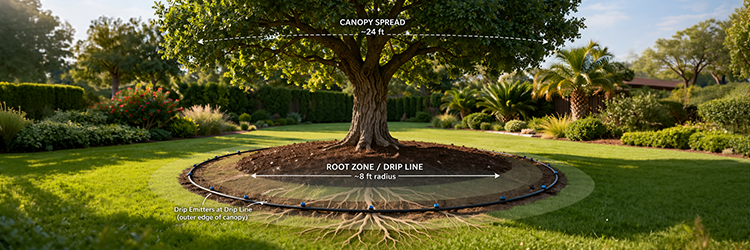
Placement is one of the most important factors in how well a drip system performs for trees. Many homeowners make the mistake of placing emitters too close to the trunk. This can actually encourage shallow roots and create moisture conditions that lead to rot or fungal problems at the base.
The correct approach is to position emitters at or beyond what is called the “drip line”, the outer edge of the tree’s canopy. This is where the feeder roots that absorb moisture are most active.
For a young tree with a canopy diameter under 15 feet, a minimum of one emitter for every 2 to 2.5 feet of canopy spread is a solid general guideline. Larger, established trees may require six or more emitters arranged in a ring to cover the entire active root area.
As trees grow, emitter placement should be adjusted to follow that expanding canopy edge. A system that worked perfectly at planting may need to be extended after a few years of growth.
Key Factors Homeowners Should Consider Before Installing
Not every drip setup is the same. Getting tree irrigation right requires thinking through several property-specific factors before any installation begins.
Tree species and size – Different species have very different water requirements. Native Florida trees like Live Oaks and Sabal Palms are adapted to local conditions and may need less supplemental irrigation. Newly planted trees need more frequent watering than established ones.
Soil type and drainage – Sandy soils drain quickly and may require more emitters or longer run times. Areas with clay-heavy soil retain moisture longer, which changes the scheduling approach.
Slope and elevation changes – Gravity affects water pressure in drip systems. Trees on elevated ground in a sloped yard may receive less water if the system isn’t designed with pressure-compensating emitters. Without this adjustment, lower-lying trees get too much water while upper trees stay dry.
Existing irrigation zones – Trees and lawn areas should ideally be on separate irrigation zones. Turfgrass and trees have different water needs and respond to different scheduling strategies. Combining them in one zone often means one or the other is being over- or under-watered.
System integration – A tree drip system should connect seamlessly with the property’s overall irrigation infrastructure, smart controllers, and water source connections.
How Often Should You Water Trees with a Drip System
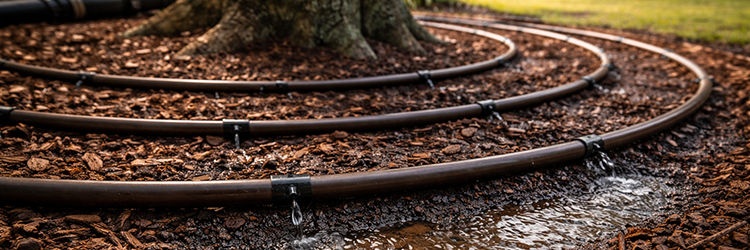
There is no single universal schedule, but some practical principles apply across most situations in Palm City’s climate.
During the dry season (typically November through April), most established trees benefit from 1 to 2 deep watering sessions per week. The goal is to moisten the soil to a depth of 12 to 18 inches, where the majority of feeder roots are active.
During the rainy season, a smart controller with a rain sensor or soil moisture sensor will automatically hold irrigation when natural rainfall is sufficient. Homeowners often find that their systems run very infrequently from June through September, which conserves water and reduces utility costs significantly.
Newly planted trees require more frequent watering, sometimes every day or two for the first few weeks, to help establish root contact with the surrounding soil. As trees mature and root systems expand, watering frequency can be gradually reduced.
Checking soil moisture manually (pressing your finger or a screwdriver a few inches into the soil near the drip line) is a reliable way to confirm whether the system is working as intended between scheduled inspections.
Common Signs Your Trees Are Not Getting Enough Water
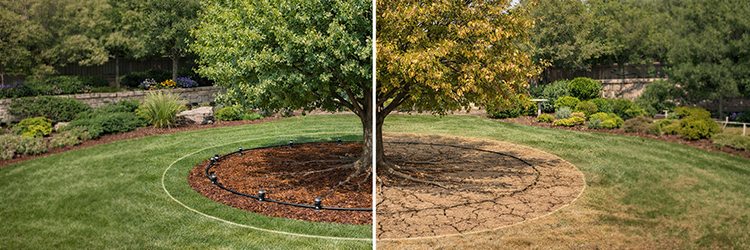
Even with a drip system in place, it is worth knowing the signs that a tree may be experiencing drought stress. This can happen if emitters become clogged, pressure drops in the system, or scheduling needs a seasonal adjustment.
Watch for these indicators:
- Wilting, curling, or yellowing leaves, especially on younger growth
- Premature leaf drop outside of normal seasonal patterns
- Bark that looks dry, cracked, or stressed at the base
- Slow, stunted growth that seems out of proportion to the season
- Brown leaf tips or scorched-looking edges on foliage
If you notice any of these signs, the first step is to inspect each emitter for clogs and confirm that water is actually reaching the root zone when the system runs. Emitters can become blocked by mineral deposits, algae, or debris over time, especially in areas with hard water or high mineral content.
This step is critical because trees require a consistent and measurable amount of moisture to stay healthy. According to the University of Florida IFAS Extension, trees in sandy soils, the dominant soil type across the Treasure Coast, should receive approximately 5 gallons of water per inch of trunk diameter during drought periods to adequately sustain root zone moisture. In practice, this level of consistency is difficult to achieve with manual watering alone, which is why a properly functioning drip system makes such a difference.
Maintaining a Drip Irrigation System for Trees
A drip system is a long-term investment, and routine maintenance keeps it performing at its best.
Basic maintenance tasks include:
- Inspecting emitters monthly for clogs or physical damage
- Flushing the mainline seasonally to clear sediment buildup
- Checking filter screens and cleaning them as needed
- Adjusting run times as seasons change, especially at the start of the dry season
- Extending emitter rings as trees grow and the canopy spreads increases
- Testing smart controllers after power outages or storms to confirm schedules are still set correctly
Professional annual inspections are also worth scheduling. A landscape irrigation expert can check pressure levels, look for underground line damage, and calibrate the system for the coming season, catching small issues before they become costly problems.
Working with Landscape Professionals for Tree Irrigation in Palm City
Designing and installing an irrigation system that properly serves your trees across varying species, soil conditions, slopes, and zones requires real expertise. It is not a project where generic, off-the-shelf solutions deliver consistent results on premium properties.
At Alpha Zeta Landscaping, our team has spent nearly four decades working with the unique soil conditions, climate patterns, and plant material that define Palm City and the Treasure Coast. We design irrigation systems that are engineered specifically for each property, integrating tree drip zones into a comprehensive water management plan that addresses every area of your landscape.
From custom emitter placement and zone configuration to smart controller programming and seasonal calibration, we approach irrigation as a precision service.
Final Takeaway
Irrigating trees with a properly designed drip system is one of the most effective long-term investments a homeowner can make in their landscape. It protects mature trees from the stress of Palm City’s demanding seasonal cycles, reduces water waste, and supports the kind of deep, resilient root development that keeps your most valuable landscape assets healthy for decades.
The difference between a tree that merely survives and one that truly thrives often comes down to how consistently and intelligently it is watered. A system designed around your specific trees, soils, and property conditions rather than a generic solution is what makes that difference real.
The team at Alpha Zeta Landscaping brings nearly 40 years of local expertise to every irrigation project we design. If your trees deserve better irrigation than they are currently receiving, we are ready to help you build a system that delivers lasting results for your Palm City property.