Key Takeaways
- Flood lights are broad-coverage fixtures best used for lawns, pool decks, perimeter zones, and security
- Proper placement depends on fixture height, beam angle, and light direction. All three must work together to avoid glare, dark zones, and light spillover
- Florida’s humidity, salt air, and hurricane season demand fixtures rated at minimum IP65, with corrosion-resistant hardware
- Flood lights work best as part of a layered lighting plan that also includes spotlights, path lights, and ambient fixtures
A well-lit backyard does more than push back the dark. It extends the usability of your outdoor space, adds a sense of security, and, when done right, transforms your landscape into something genuinely beautiful after sunset. But flood lights for backyards are frequently misunderstood. Homeowners either go too bright, too dim, or place them in spots that create more problems than they solve.
If you own a premium property in Palm City or anywhere along Florida’s Treasure Coast, your backyard deserves a lighting strategy.
What Exactly Is a Flood Light for a Backyard
A flood light is a wide-angle, high-intensity outdoor light designed to wash large areas with even, consistent illumination. Unlike spotlights that concentrate a narrow beam on a single object, flood lights spread light broadly across open spaces, making them ideal for lawns, pool decks, open patio areas, and property perimeters.
Most modern backyard flood lights use LED technology. LED flood lights consume less energy than traditional halogen or incandescent fixtures while producing the same or greater brightness. For a Florida homeowner running outdoor lights most evenings of the year, that efficiency difference adds up significantly on the annual energy bill.
Why Does Strategic Placement Matter More Than Most Homeowners Realize
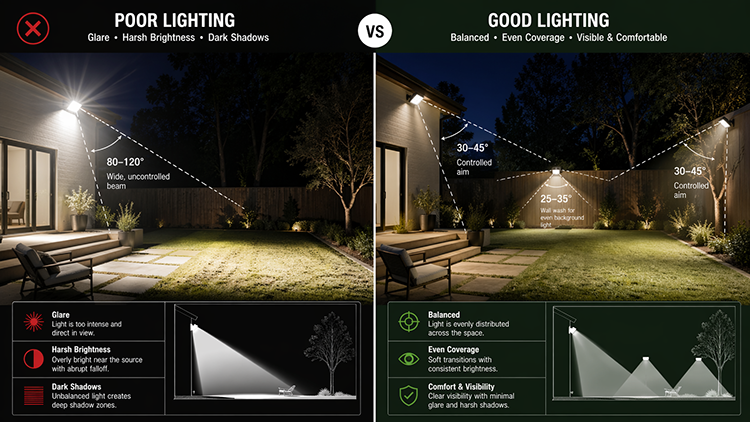
This is where most DIY lighting projects go wrong. Flood lights installed without a placement strategy tend to create three common problems:
- Glare – Light aimed at the wrong angle hits the eyes directly instead of illuminating surfaces
- Dark zones – Overly concentrated placement leaves large gaps of shadow
- Light pollution – Poorly aimed fixtures push light upward or outward, annoying neighbors and wasting energy
Strategic placement means thinking about your backyard in zones. A large backyard in Palm City might include a pool deck, a lawn area, a garden border, a seating space, and a property boundary. Each with different lighting needs and appropriate brightness levels.
Good flood light placement considers three things: the height of the fixture, the beam angle, and the direction of the light. Mounting a flood light too low reduces coverage. Mounting it too high without adjusting the angle can flood a neighbor’s yard. Professional landscape lighting designers account for all three variables before a single fixture goes in.
How Bright Should Backyard Flood Lights Actually Be
Brightness in flood lights is measured in lumens, not watts. Watts measure energy consumption; lumens measure light output. Understanding this distinction helps homeowners make smarter choices.
Here’s a general guide for backyard applications:
- 700 – 1,300 lumens – Suitable for pathways, garden beds, and accent areas
- 1,500 – 3,000 lumens – Appropriate for mid-size lawns, pool decks, and open patios
- 3,000+ lumens – Best for large open properties, perimeter security lighting, and wide coverage zones
The trend toward LED outdoor lighting is accelerating. According to the U.S. Energy Information Administration’s Residential Energy Consumption Survey, 77% of the estimated 58 million U.S. homes with outdoor lights left on all night were already using at least one LED bulb. For upscale homes in Palm City, where outdoor entertaining and landscape aesthetics are priorities, the goal is usually layered brightness. Bright flood lights for security along the perimeter pair with softer, warmer illumination over seating areas. This layering creates depth and visual appeal rather than a flat, stadium-like effect.
What Color Temperature Is Right for a Florida Backyard
Color temperature: measured in Kelvin (K) determines whether your lighting looks warm and amber or cool and white.
- 2,700K – 3,000K: Warm white, similar to incandescent light. Creates a relaxed, welcoming atmosphere around seating and pool areas.
- 3,500K – 4,000K: Neutral white. Balances warmth and visibility. Works well across general lawn areas.
- 5,000K+: Daylight white. Very bright and clinical. Best suited for pure security applications, not aesthetic lighting.
In coastal Florida landscapes, warm to neutral color temperatures tend to complement tropical foliage, palm trees, and natural stonework far better than harsh cool-white light.
What Makes Florida Backyards Different from Other Climates
Palm City’s environment presents specific challenges that affect outdoor lighting decisions.
Florida’s humidity, salt air, and intense UV exposure degrade poorly rated fixtures quickly. Any flood light installed outdoors here should carry a minimum IP65 rating, which indicates dust-tight construction and resistance to water jets. In coastal zones or properties near water, IP66 or IP67 is worth the investment.
Florida also averages around 237 sunny days per year, which is excellent news for solar-powered flood light options. Solar flood lights have advanced significantly. Modern units store enough daytime energy to run reliably through the night, even after a cloudy day. For properties where running new wiring is costly or disruptive, solar fixtures offer a practical alternative in Florida’s climate.
Additionally, Florida’s hurricane season is a real consideration. Fixtures should be mounted securely with corrosion-resistant hardware and rated for wind and rain exposure. This is not something to skip to save money upfront.
How Do Flood Lights Fit Into a Larger Landscape Lighting Design
This question gets to the heart of professional outdoor lighting. Flood lights are one tool in a larger system.
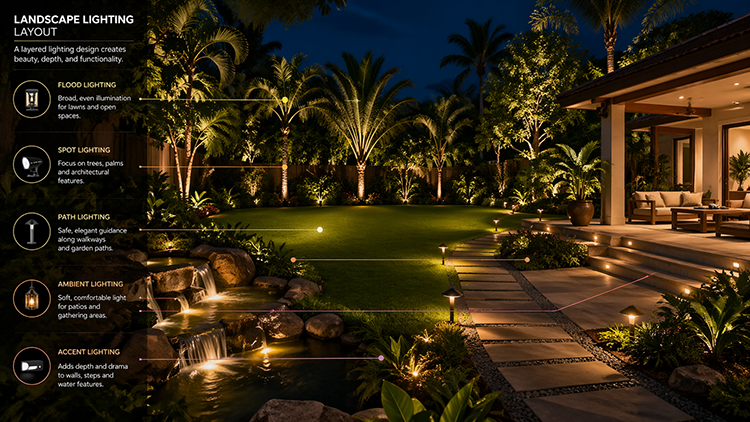
A thoughtfully designed backyard lighting plan typically combines:
- Flood lights for broad coverage of open lawn, perimeter, and security zones
- Spotlights for uplighting trees, architectural features, and focal points
- Path lights for walkways, steps, and garden borders
- In-ground or underwater lights for pools and water features
- String lights or ambient fixtures for covered patio and entertainment areas
When flood lights are integrated alongside these other elements, the result is a layered, dimensional landscape that looks professionally designed because it is. Flood lights used alone, without this context, tend to flatten the landscape and eliminate the shadows and depth that make outdoor spaces look beautiful at night.
For homeowners in Palm City with premium properties, this design integration is what separates a truly elevated outdoor space from a simply well-lit one.
Common Mistakes Homeowners Make with Backyard Flood Lights
Even well-intentioned homeowners frequently run into these issues:
- Over-illuminating small spaces – Using high-lumen flood lights in compact areas creates harsh, uncomfortable brightness
- Ignoring beam angle – A 120-degree beam placed in the wrong location spills light in unintended directions
- Choosing the wrong mounting location – Wall-mounted lights near eaves often create sharp shadows and uneven coverage
- Skipping controls – Flood lights without dimmers, timers, or motion sensors waste energy and limit flexibility
- Mismatching color temperatures – Mixing 3,000K and 5,000K fixtures in the same space looks disjointed and unfinished
These mistakes are avoidable. But for most homeowners without lighting experience, they only become visible after installation, when fixing them means additional cost and disruption.
Why Should You Work With a Professional Landscape Lighting Designer
The honest answer is that outdoor lighting design involves more variables than most homeowners anticipate and the consequences of getting it wrong are visible every single evening.
Professional landscape lighting designers bring technical knowledge of lumen output, beam angles, fixture placement, and electrical load capacity. They also bring aesthetic judgment an understanding of how light and shadow interact with your specific landscape, architecture, and plantings.
At Alpha Zeta Landscaping, our team brings nearly four decades of experience designing and installing landscape lighting for upscale properties in Palm City and across the Treasure Coast. We understand Florida’s coastal environment, its unique plant palette, and the demands that humidity and salt air place on outdoor fixtures. We plan it with precision.
Final Thoughts
A flood light for a backyard is a powerful tool but only when placed with intention, sized correctly for the space, and integrated into a broader lighting design. For Palm City homeowners who have invested in a premium property, settling for a few fixtures screwed into the wall is a missed opportunity.
The right lighting strategy doesn’t just make your backyard safer. It makes it the kind of outdoor space you actually want to spend time in and one that reflects the quality of everything else you’ve built. Working with experienced landscape lighting professionals like the team at Alpha Zeta Landscaping ensures that every fixture, every angle, and every lumen work together to deliver a result worth coming home to.