Key Takeaways
- Native landscaping relies on deep, well-adapted root systems that hold soil in place during Palm City’s heavy rain and storm seasons.
- Native plants resist local pests and diseases naturally, which means less reliance on chemical treatments.
- These plants tolerate drought and Palm City’s sandy soil without constant watering or special care.
- A yard built around native landscaping typically costs less to water and maintain over time.
- Getting the plant mix and placement right still takes a trained eye, not a guess at the nursery.
At Alpha Zeta Landscaping, we have spent nearly four decades designing landscapes along Florida’s coast, and one pattern keeps showing up: yards built around native plants hold up. Yards built around plants that were never meant to grow here tend to struggle.
Palm City’s climate is generous with sunshine, but it is also demanding. Heavy summer rain, tropical storm season, and sandy soil put constant pressure on a landscape, and plants that were not built for this environment often need frequent watering, fertilizing, and replacing after a rough season.
This article looks at why native landscaping performs so differently here, and what that resilience actually means for your property over the long run.
How do native plants protect Palm City yards during heavy rain and storms?
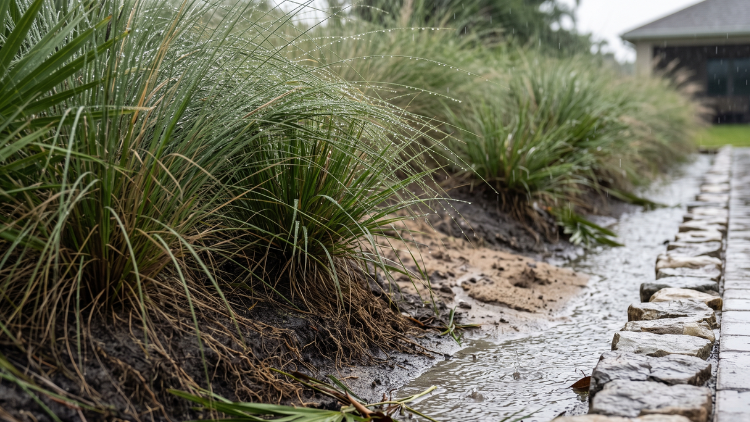
Palm City often sees its heaviest rainfall between June and September, and it tends to arrive in short, intense bursts rather than a steady drizzle. A landscape needs to handle that kind of water quickly, or the yard pays for it in erosion, washed out beds, and standing water.
Native plants are built for this pattern. Because they evolved alongside Florida’s wet and dry cycles, many grow deeper, more extensive root systems than common turf grasses or imported ornamentals.
- Deeper roots anchor soil on slopes, along fence lines, and near drainage paths
- Denser root networks help rain soak into the ground instead of running off the surface
- Established native beds tend to bounce back faster after a tropical storm than freshly replanted ornamental beds
A native plant comparison published through the U.S. Environmental Protection Agency found that ordinary turf grass roots typically reach only one to two inches into the soil, while native plantings can send roots several feet down in search of water, substantially increasing how much rainfall the soil can absorb and hold rather than shed as runoff. In a Palm City yard, that difference shows up as fewer washed out beds after a summer storm.
Why do native plants resist pests and diseases without chemical treatment?
Homeowners with imported ornamentals often end up on a spray schedule: fungicide for one problem, insecticide for another, fertilizer to keep the plant alive long enough to bloom. Native plants rarely need that level of intervention.
They evolved alongside Florida’s local insects, fungi, and soil conditions, so most carry built-in defenses that non-native species simply never developed.
- Fewer pest outbreaks, since local insect populations are already kept in check by natural predators the plants attract
- Less disease pressure, since native species are not fighting fungi and pathogens they never adapted to
- Reduced need for fertilizer, since heavy feeding can make plants weaker and more attractive to pests
The University of Florida’s Institute of Food and Agricultural Sciences notes that Florida’s native plants evolved in nutrient-poor, sandy soil, so they generally do not need fertilizer or heavy pest control to stay healthy the way many non-native ornamentals do. For homeowners who want a chemical-light yard, that is a meaningful advantage.
What makes native plants so tolerant of drought and sandy soil?
Much of Palm City’s soil is sandy, which means water and nutrients drain through it fast. Ornamental plants bred for other climates often struggle here between rainy periods, wilting and browning within days of a dry stretch.
Native plants handle this differently. Their root systems are built to chase moisture deeper into sandy soil, and their growth habits are adapted to hold up during dry spells without constant watering.
- Many native species only need supplemental watering while they are getting established, not for the life of the plant
- Their tolerance for sandy, low-nutrient soil means they do not need heavy soil amendments to survive
- They handle Palm City’s swing between soaked summers and drier stretches without the stress that shows up in non-native plantings
This is one of the quieter benefits of native landscaping. These plants do not just survive drought; they do it without the constant babying that keeps a homeowner tied to a watering can or an irrigation timer.
What long-term savings come from choosing native landscaping?
The upfront cost of a landscape is only part of the picture. The real cost shows up over the years, in water bills, fertilizer, pest treatments, and the price of replacing plants that did not make it through storm season.
Native landscaping shifts that math. Because these plants need less water, less feeding, and less rescuing after bad weather, the ongoing cost of the yard drops noticeably compared to a high-maintenance ornamental landscape.
- Lower irrigation costs, since native plants need far less supplemental watering once established
- Fewer replacement costs after tropical storms and dry spells
- Less spent on fertilizer and pest treatments over the life of the landscape
Why does professional design still matter for native landscaping?
It might seem like native landscaping is a simple swap: pull out the ornamentals, drop in something local, and let nature handle the rest. In practice, it still needs the same care in planning that any premium landscape does.
Not every native plant belongs in every spot. A species built for a shaded, well-drained upland site will struggle in a low, wet corner of your yard, and the reverse is just as true. Getting this wrong wastes money and undercuts the very resilience you are trying to build.
A proper native landscape plan accounts for:
- Soil composition and drainage patterns across the property
- Sun exposure and how it shifts through the seasons
- Placement relative to your home’s foundation, pool, and hardscaping
- How the plant palette will mature and fill in over several years
This is where our landscape design and build services in Palm City come in. We walk each property, evaluate drainage and site conditions, and build a native plant palette suited to that specific spot, rather than guessing at what looked good in a nursery display.
Final Takeaway
- A native landscape holds soil, resists pests, and survives dry spells with far less ongoing intervention than an imported ornamental yard.
- That resilience translates into lower water bills, less fertilizer and pest control spending, and fewer replacements after storms.
- Success still depends on matching the right plant to the right spot, based on soil, drainage, and sun exposure.
- A thoughtful native plant palette can look just as refined as a traditional high-end landscape, without the constant upkeep.
Closing
Palm City rewards landscapes that are built to match its climate, not fight against it. Native landscaping gives homeowners a way to have a yard that looks intentional and premium while actually asking less of them season after season.
At Alpha Zeta Landscaping, we bring nearly four decades of coastal Florida experience to every native landscape we design, helping homeowners build outdoor spaces that hold up to Palm City’s weather and hold their value for years to come.
FAQs
Will a native landscape look manicured, or wild and messy?
A well-designed native landscape can look just as clean and intentional as any traditional ornamental yard. The finished look comes down to design choices like plant spacing, edging, and structure, not the fact that the plants happen to be native.
How long does it take for native plants to become established?
Most native plants take one full growing season, roughly six to twelve months, to develop the root systems that make them low maintenance. During that window, they still need regular watering, similar to any new planting.
Can I mix native plants into my existing landscape instead of starting over?
Yes, native plants can be introduced gradually into an existing yard, especially in beds that struggle the most or need frequent replacement. A phased approach lets you build resilience over time without redoing the entire property at once.