Uplighting for trees in Palm City usually costs about $100 to $400 per installed fixture. A single cabbage palm might run $150 to $400 to light, while a broad live oak that needs three or four fixtures can reach $1,200 or more. Whether that money lasts depends on fixture material, wiring quality and simple upkeep in salt air.
How much does it cost to uplight a tree in Palm City?
Most single trees cost a few hundred dollars to uplight, and the fixture count per tree moves the total most. A slim palm needs one light; a wide canopy needs several from different sides, or it looks flat.
| Tree type | Typical fixtures | Rough installed cost |
| Cabbage (sabal) palm or Christmas palm | 1 | $100 to $400 |
| Royal palm or tall foxtail palm | 1 to 2 | $200 to $800 |
| Clustered palms (areca, triple foxtail) | 2 | $200 to $800 |
| Mature live oak or gumbo limbo | 3 to 4 | $300 to $1,600 |
These are general ranges from national cost guides. Complete professional systems that light several trees, a walkway and the house commonly land around $2,000 to $5,000.
Good landscape lighting design and installation starts with choosing which trees deserve light.
What changes the price of tree uplighting?
After fixture count, price comes down to:
- Fixture material. Solid brass or copper costs more up front than painted aluminum but usually outlasts it near the coast.
- Transformer size. Low-voltage systems run through a transformer sized to the total wattage. Adding trees later may mean a bigger one.
- Distance and roots. Trees far from an outlet need longer wire runs. University of Florida research on root spread shows roots commonly reach two to three times past the edge of the canopy, so careful crews use shallow slits or hand digging rather than trenching straight through them. Our guide to drip irrigation for trees explains why those feeder roots matter.
- Controls. Timers, photocells or app control add a modest cost and cut run time.
Pairing lighting with a design and build project lets wire go in before beds and pavers, which saves digging later.
Are solar tree spotlights worth it in Florida?
For uplighting trees, solar spotlights rarely work as a long-term answer. The tree’s own canopy shades the panel, and units that do get full sun usually can’t throw enough light to reach the fronds of a 30-foot royal palm.
They also fade after cloudy summer afternoons, and their batteries and plastic housings wear out fast in strong sun. Wired low-voltage LED uplights cost more at the start but use very little power.
According to the U.S. Department of Energy’s LED guidance, residential LEDs use at least 75% less energy and last up to 25 times longer than incandescent bulbs. Solar still suits a small accent in full sun. For broad light rather than accents, see our post on using flood lights in the backyard.
Which fixture materials hold up in salt air?
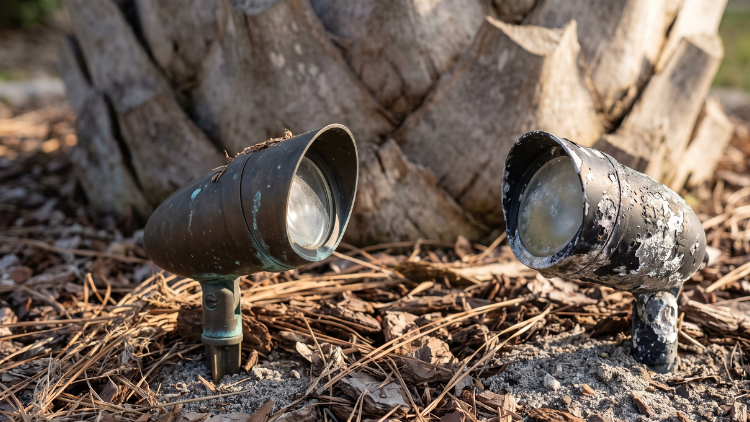
Solid brass and copper hold up best near the St. Lucie River and the coast, because they weather to a dark protective patina instead of corroding through. Painted or powder-coated aluminum is cheaper, but salt gets under any scratch, and the coating often bubbles and pits within a few years.
Hidden parts matter just as much: sealed lens gaskets, stainless screws, direct-burial wire and waterproof gel-filled or heat-shrink connectors. Cheap twist-on connectors in damp, sandy soil corrode fast and often take a whole run dark. Salt rides the breeze well inland, so this applies across the Treasure Coast service area.
What maintenance does tree uplighting need?
Plan on a check once or twice a year, plus a look after any tropical storm. Most upkeep is adjustment:
- Re-aim fixtures as palms gain height and oaks fill in, so the light stays on the canopy.
- Pull back mulch, grass and sand that creep over lenses and dim them.
- Wipe hard-water spots left by sprinkler overspray, and adjust heads that hit fixtures directly.
- Test connections and the transformer after storms. Hurricane season runs June 1 through November 30.
Overspray is an easy fix with an irrigation system tune-up. For a plan built around your trees and salt exposure, call Alpha Zeta Landscaping at (772) 283-4123. You can also talk to our team online. We offer ongoing maintenance too, from seasonal adjustments to lens cleaning and fixture replacement.
How long does a tree uplighting system last?
A well-built low-voltage LED system near the coast can often last 15 years or more with brass or copper fixtures, while budget aluminum may need replacing in three to seven years. Transformers commonly last a decade or longer.
The dry months after rainy season make installation cleaner, as our post on why December is a smart time for lighting upgrades explains. Our backyard garden lighting ideas show how lit trees fit into a full design.
Final Takeaway
- Fixture count per tree drives cost more than anything else, so choose your key trees first.
- In salt air, brass or copper fixtures and sealed connections are what make a system last.
- Yearly re-aiming and a post-storm check keep growing palms and oaks lit the way they were designed.
FAQs
Can uplights damage a tree?
LED uplights run cool. The real risk is cutting roots while running wire, which careful installation avoids.
Can I add more trees to my lighting later?
Usually. If the transformer has spare capacity, new fixtures join the existing run; if not, a larger one may be needed.
Should tree uplights stay on all night?
Most homeowners set a timer to run them from dusk to late evening, which saves energy and is kinder to neighbors and wildlife.