If you are building a custom home in Martin County, plan the landscape before the builder sets final grade, not after the walls go up. The county requires Florida native trees on new single-family lots (generally one tree for every 3,000 square feet of developable lot area), prohibited invasive plants must be removed before the Certificate of Occupancy, and existing native trees you save can count for extra credit. Bringing a landscape designer in early protects those trees, gets irrigation and lighting sleeves in before the driveway is poured, and avoids paying twice to fix grade and soil.
Here is what the county requires, what to do at each construction stage, and where new-home landscapes most often go wrong.
Key takeaways
- Martin County requires Florida native trees on lots for new single-family and duplex homes, planted or preserved under Article 4, Division 15 of the Land Development Regulations.
- The base rule is one tree per 3,000 sq ft of developable lot size. On larger lots, 75% of planted trees must be South Florida natives.
- Saving existing native trees can earn more credit than planting new ones. A native tree 13 to 18 inches in diameter counts as three trees.
- All prohibited vegetation (such as Brazilian pepper and Australian pine) must be removed before the Certificate of Occupancy is issued.
- New-construction soil is usually compacted fill sand, sometimes with buried debris. Plan for soil correction before planting.
What does Martin County require for new single-family homes?
According to Martin County Growth Management’s guidance for single-family and duplex homes:
- Tree quantity: one tree for every 3,000 square feet of total developable lot size (excluding preserve areas).
- Native share: on lots requiring four or more trees, 75% of the trees planted must be South Florida native species. Smaller lots require 100% native.
- Palms: two palms count as one tree, palms can make up no more than 30% of required trees, and palms only count when four or more trees are required.
- Size: where three or fewer trees are required, each must be at least 3-inch diameter at breast height (DBH), 12 feet tall, with a 6-foot crown spread and capable of reaching 20 feet. On larger requirements, trees must be at least 2-inch DBH and 10 feet tall.
- Prohibited species: all prohibited trees, shrubs and ground covers must be removed before the C.O.
Selected rows from the county’s planting schedule:
| Lot size (sq ft) | Trees required | Native % | Max palm credits | Minimum size |
|---|---|---|---|---|
| 6,000 to 7,499 | 2 | 100% | 0 | 12 ft, 3-inch DBH |
| 7,500 to 10,499 | 3 | 100% | 0 | 12 ft, 3-inch DBH |
| 10,500 to 13,499 | 4 | 75% | 1 (2 palms) | 10 ft, 2-inch DBH |
| 19,500 to 22,499 | 7 | 75% | 2 (4 palms) | 10 ft, 2-inch DBH |
| 28,500 to 31,499 | 10 | 75% | 3 (6 palms) | 10 ft, 2-inch DBH |
| 43,500 and larger | 15 | 75% | 4 (8 palms) | 10 ft, 2-inch DBH |
The specific native trees required for your lot are identified in the conditions added to your building permit. Confirm the current requirements with Martin County Growth Management for your parcel, since homes inside municipalities like Stuart or Sewall’s Point follow their own codes.
Why does saving existing trees matter so much?
Because the county gives existing native trees more credit than new ones:
| Existing native tree (DBH) | Tree credits |
|---|---|
| 2 to 6 inches | 1 |
| 7 to 12 inches | 2 |
| 13 to 18 inches | 3 |
| 19 to 24 inches | 4 |
| 25 to 30 inches | 5 |
| 31 to 36 inches | 8 |
A single mature live oak can satisfy a large share of a lot’s requirement, and it delivers shade and scale no new planting can match for decades. Protected trees must be shown on the land clearing plan, so this decision has to happen before clearing, not after. It is one of the strongest reasons to involve a landscape designer at the lot-planning stage.
When should a landscape designer get involved?
Earlier than most homeowners think. Here is the sequence that works.
1. Before clearing: tree survey and preservation plan. Identify native trees worth keeping, mark protection zones, and get them on the land clearing plan.
2. During construction: protect roots and soil. Keep equipment, fill and material piles out of tree protection zones. Ask the builder not to bury concrete washout, drywall or block in future planting areas. UF/IFAS notes that construction debris like concrete can raise soil pH and restrict root growth in new landscapes.
3. Before final grade and flatwork: drainage, sleeves and conduit. This is the most expensive step to miss. Irrigation sleeves and low-voltage lighting conduit should run under the driveway and walks before they are poured or paved. Final grading should move water away from the house and toward approved drainage.
4. Soil correction. UF/IFAS describes typical new-home sites as fill sand spread over buried native topsoil, compacted by equipment, with little organic matter. Loosening compacted areas and amending planting beds before installation is far cheaper than replacing failing plants.
5. Installation. Trees and palms first, then irrigation (with the rain shutoff device Florida law requires on automatic systems), beds, sod and lighting.
6. Establishment. The South Florida Water Management District allows extra watering for up to 90 days after new landscaping is installed. Have a plan for who manages that schedule, especially if you are not living in the home yet.
Our custom landscape design process walks through how we coordinate these stages with builders.
What do builders’ landscape packages usually leave out?
If your builder includes a landscape allowance, ask exactly what it covers. Questions to ask:
- Does it meet only the county’s minimum tree requirement, or a full design?
- What sizes are the trees, palms and shrubs?
- Is irrigation designed by zone (lawn separate from beds), or a basic layout?
- Are lighting conduit and irrigation sleeves included under hardscape?
- Is soil preparation included, or is sod laid directly on compacted fill?
- Who warranties the plants, and for how long?
Many custom-home owners use the builder’s allowance for code compliance and hire a design-build landscape firm for everything else, coordinating timing so the two do not overlap.
Which trees should anchor a new Treasure Coast landscape?
Pick the trees for the long term, because they are the hardest part of the landscape to change later. UF/IFAS research across multiple hurricanes ranked live oak and sabal palm among the most wind-resistant species studied, and sabal palm is a native that also counts toward palm credits. Our guide to native landscaping in Palm City covers more native trees and shrubs that perform well here.
What a finished new-home landscape looks like
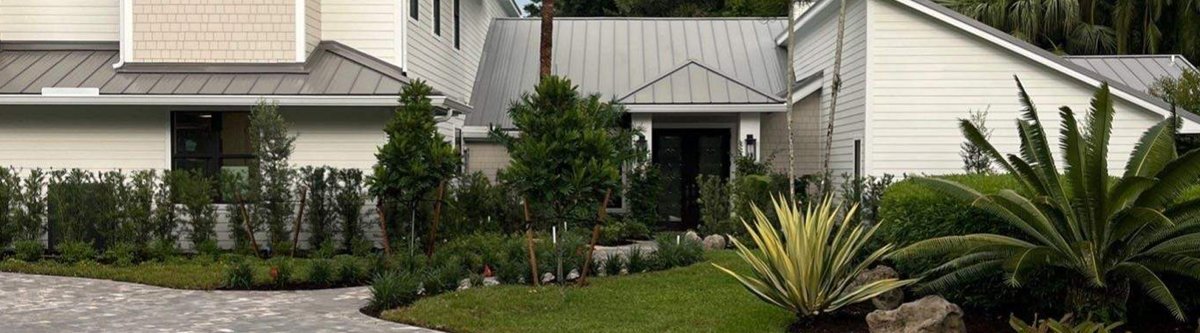
This coastal home shows what a coordinated new-home landscape looks like on day one: a curved gray paver driveway that meets the front walk, a continuous hedge line softening the foundation, newly braced young trees spaced to grow into a canopy, and bold accent plants like agave and cycads at the bed edges for structure. Nothing looks like an afterthought because the driveway, beds and lawn were planned as one composition.
Final takeaway
For a new custom home in Martin County, the landscape is part of the build. Save native trees before clearing, protect soil during construction, run sleeves and conduit before flatwork, and correct the soil before you plant. Do that, and you will meet the county’s tree requirement with a landscape that looks finished at move-in and keeps improving.
Building in Palm City, Stuart, Hobe Sound or Jupiter Island? Alpha Zeta coordinates directly with custom home builders, from tree preservation through final installation and establishment care. Request a proposal or call (772) 283-4123 as early as the lot-planning stage. Not sure who to hire for design? See landscape designer vs. landscape architect vs. design-build.
FAQs
How many trees does Martin County require for a new house?
Generally one tree for every 3,000 square feet of developable lot size. For example, a 7,500 to 10,499 square foot lot requires three trees, and a lot of 43,500 square feet or more requires 15. Smaller lots require 100% native trees; larger lots require 75% South Florida natives.
Can palm trees count toward Martin County’s tree requirement?
Yes, in limited cases. Two palms count as one tree, palms can make up no more than 30% of required trees, and palms only count when four or more trees are required.
Do existing trees count toward the requirement?
Yes, and they often count for more. Existing native trees earn credits by trunk diameter, from one credit for a 2 to 6 inch tree up to eight credits for a 31 to 36 inch tree. They must be shown as protected on the land clearing plan.
When should I hire a landscape designer for a new home?
Ideally before land clearing, so native trees can be preserved and credited. At minimum, before final grade and before the driveway and walks are installed, so irrigation sleeves, lighting conduit and drainage can be built in.
Does my HOA control my new home’s landscaping?
Usually yes, through architectural review. Florida law (s. 720.3075, F.S.) prevents HOAs from prohibiting Florida-Friendly Landscaping, but associations can still require plan approval and reasonable standards.
Sources
- Martin County Growth Management, Landscaping Requirements for Single-Family or Duplex Homes: https://www.martin.fl.us/resources/landscaping-requirements-for-sfr-and-duplexes
- Martin County, Tree Requirements, Regulations and FAQs: https://www.martin.fl.us/tree-requirements-regulations-and-faqs
- UF/IFAS EDIS, The Role of Soil Management in Minimizing Water and Nutrient Losses from the Urban Landscape (SS593): https://ask.ifas.ufl.edu/publication/SS593
- UF/IFAS EDIS, Selecting Coastal Plain Species for Wind Resistance (FOR119): https://ask.ifas.ufl.edu/fr174
- South Florida Water Management District, Landscape Irrigation: https://www.sfwmd.gov/community-residents/landscape-irrigation
- UF/IFAS AE221, Rain sensors and Florida Statute 373.62: https://ask.ifas.ufl.edu/publication/AE221
- Florida Statutes s. 720.3075: https://flsenate.gov/laws/statutes/2024/720.3075