Key Takeaways: Why Your Lawn Is Turning Yellow
Before diving into the full breakdown, here is a quick-reference summary of the most important points covered in this guide.
- Yellow grass is a symptom, not a problem in itself. The discoloration is your lawn is signaling an underlying imbalance, whether in water, nutrients, soil, pest pressure, or mowing practices.
- Overwatering and underwatering look nearly identical. Both cause yellowing and weak roots. Calibrated irrigation is essential, not guesswork.
- Chinch bugs, sod webworms, and grubs are the most common pest culprits behind yellow lawn patches in Palm City, and each requires a different treatment approach.
- Fungal diseases, such as large patches and dollar spot, thrive in Florida’s humidity and produce distinctive yellow patterns that are often mistaken for water or nutrient issues.
- Nitrogen deficiency causes uniform yellowing; iron deficiency causes yellow blades with green veins. Soil testing is the only reliable way to tell the difference.
- Mowing too short (scalping) and using dull blades are among the most preventable causes of yellow grass, yet they remain extremely common.
- The pattern and location of yellowing provide critical diagnostic clues. Uniform yellowing, circular patches, and striped patterns each point to different root causes.
- Recurring or fast-spreading yellow lawn problems require professional diagnosis. Generic treatments applied without identifying the actual cause rarely resolve the issue and can delay proper correction.
- Routine professional lawn maintenance is the most cost-effective way to prevent yellow lawns by addressing irrigation, fertilization, pest monitoring, and mowing as a coordinated system rather than isolated fixes.
A lush, green lawn is one of the most defining features of a well-maintained Palm City property. So when patches of yellow begin spreading across your turf, it can feel alarming, and for good reason. Yellow grass is rarely just a cosmetic issue. It is almost always a signal that something in your lawn’s environment is out of balance, whether that is water, nutrients, soil health, pest activity, or mowing practices. Left unaddressed, the underlying causes of a yellow lawn can lead to thinning turf, bare patches, and significant long-term damage that becomes far more costly to reverse than to prevent.
At Alpha Zeta Landscaping, we have spent nearly four decades diagnosing and correcting lawn problems throughout Palm City and the Treasure Coast. In that time, we have seen every variety of yellow lawn imaginable, and we know that identifying the root cause quickly is the difference between a simple correction and an expensive turf replacement.
This guide walks through the most common reasons lawns turn yellow in Florida, what each symptom looks like, and how routine professional lawn care keeps your turf green, healthy, and visually impressive year-round.
Overwatering and Underwatering: The Two Fastest Ways to Yellow a Lawn
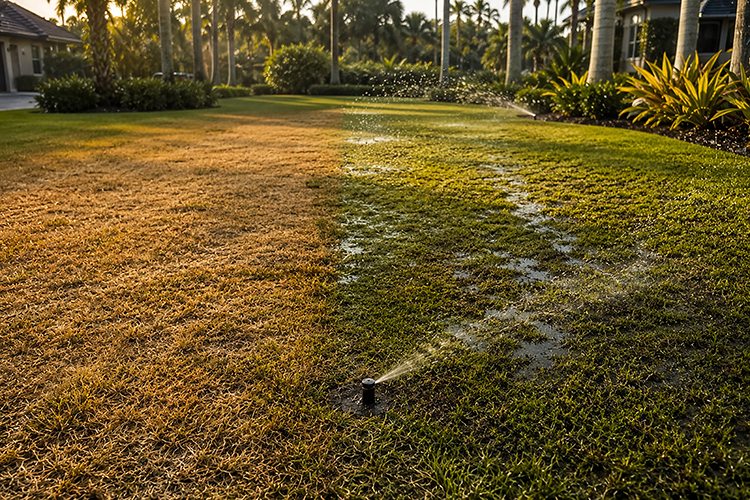
Watering mistakes are among the most frequent causes of a yellow lawn in Palm City, and the frustrating truth is that too much water and too little water can produce almost identical symptoms: yellowing blades, weak root systems, and turf that looks stressed even during otherwise favorable weather.
Overwatering creates soggy soil conditions that deprive roots of oxygen, leading to shallow root development and a lawn that is perpetually vulnerable. Wet conditions also create the ideal environment for fungal diseases, which bring their own patterns of yellow and brown discoloration. In Florida’s subtropical climate, where humidity is already high, excess irrigation accelerates these problems significantly.
Underwatering triggers a different but equally damaging stress response. Turf grass in drought stress will turn yellow or straw-colored as it conserves moisture, eventually going dormant and dying in sections if conditions persist. St. Augustine and Zoysia grass, both common in Palm City, are particularly sensitive to prolonged dry periods.
The solution is rarely “water more” or “water less” in isolation. Proper irrigation requires calibrated scheduling based on soil type, turf variety, rainfall totals, and seasonal conditions. A professional lawn care program includes irrigation monitoring and adjustment as a standard component, ensuring your turf receives exactly what it needs, nothing more and nothing less.
Lawn Pests That Cause Yellow Grass in Palm City
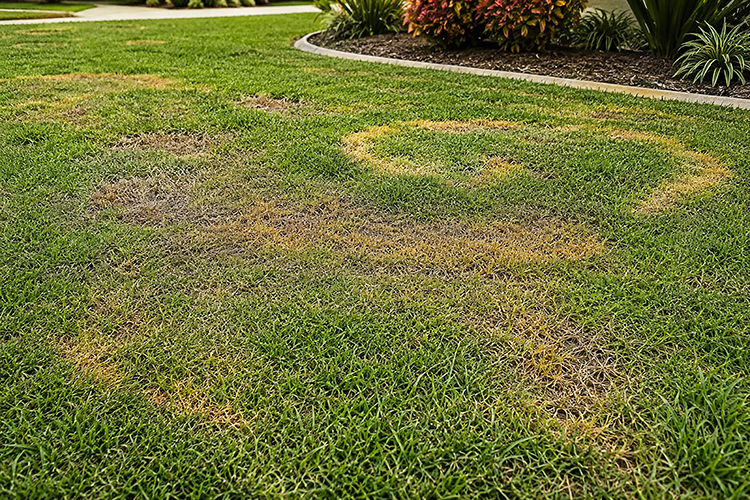
Several insects common to South Florida feed on turf grass in ways that produce widespread yellow discoloration. Many homeowners mistake pest damage for a watering problem, applying more irrigation when the real culprit is underground or hiding in the thatch layer.
Chinch bugs are among the most destructive pests affecting St. Augustine lawns in Florida. They feed by sucking fluids from grass blades and injecting a toxin that causes circular patches of yellow and brown turf that expand rapidly in hot, dry weather. If you notice yellow patches appearing in sunny, high-traffic areas and irrigation is not resolving the problem, chinch bugs are a strong suspect.
Sod webworms are the larval stage of lawn moths. They feed on grass blades near the soil surface, leaving ragged, yellowed patches that can resemble drought stress. The damage often appears overnight, and infestations can strip large sections of turf quickly during warm months.
Grubs (the larvae of beetles, including the June beetle) feed on grass roots below the soil surface.
A grub-damaged lawn will appear yellow and wilted, and affected sections will pull up easily from the soil because the roots have been severed. This root damage also makes the lawn highly vulnerable to secondary drought stress and disease.
Early identification is critical with pest damage. By the time yellowing becomes widespread, infestations are often already significant. Professional lawn care teams inspect for pest activity during every visit, enabling targeted treatment before damage escalates.
Lawn Diseases That Turn Grass Yellow
Florida’s warm temperatures and high humidity create favorable conditions for a range of fungal diseases, many of which present as yellow patches, streaks, or rings on the lawn.
Large patch (formerly brown patch) is one of the most common turf diseases in Palm City, affecting St. Augustine and Zoysia grass primarily in fall and spring when temperatures fluctuate. It produces large circular patches of yellow and tan discoloration that can expand to several feet in diameter. The outer edges of the patch often display a distinctive orange or yellow halo during active infection.
Dollar spot causes small, bleached, silver-dollar-sized patches of yellow grass, usually appearing in clusters. It is common in lawns with low nitrogen levels and is worsened by morning dew and excess thatch.
Take-all root rot is a particularly damaging disease in Florida that attacks the root system directly, causing turf to thin and yellow in irregular patterns. It is often misdiagnosed as a watering or nutrition problem because the foliage symptoms appear long after root damage has occurred.
Accurate disease diagnosis requires a trained eye. Different fungal diseases require different fungicide treatments, and misapplication can waste money while leaving the underlying problem unresolved. Routine professional lawn maintenance includes monitoring for early disease indicators so that treatment can begin before a minor infection becomes a widespread infestation.
Poor Soil Conditions and Nutrient Deficiencies That Cause Yellow Lawn Patches
Florida’s sandy soils are notoriously low in nutrient retention, and without a consistent, science-based fertilization program, lawns in Palm City can quickly develop deficiencies that manifest as yellow discoloration.
Nitrogen deficiency is the most common nutritional cause of a yellow lawn. Nitrogen is responsible for the deep green color of healthy turf, and when levels are insufficient, grass blades turn pale yellow starting from the tips. The yellowing is usually uniform across the lawn rather than patchy.
Iron deficiency (iron chlorosis) causes a distinctive yellowing pattern where the grass blades turn yellow, but the veins remain green. This condition is especially prevalent in alkaline soils, which are common in coastal South Florida. High soil pH prevents roots from absorbing iron even when it is present, making pH correction a necessary step alongside iron supplementation.
Compacted soil prevents water, nutrients, and oxygen from reaching the root zone, effectively starving the grass from below. Compacted soil can severely limit how water moves into the ground, preventing grass roots from receiving the oxygen, moisture, and nutrients they need to thrive, even when lawns are regularly watered and fertilized. Compaction is particularly common in high-traffic areas and in properties with heavy clay subsoil beneath the sandy surface layer. Core aeration, which is a standard component of comprehensive lawn care programs, relieves compaction and restores the soil’s capacity to support healthy turf.
Soil testing is the most reliable way to identify deficiencies and pH issues. At Alpha Zeta Landscaping, our lawn care assessments evaluate soil conditions specifically, allowing us to develop fertilization programs that correct existing deficiencies and prevent future imbalances.
Mowing Mistakes That Lead to a Yellow Lawn
The way a lawn is mowed has a profound effect on its color and overall health. Several common mowing errors can directly cause or worsen yellow lawn conditions.
Scalping the lawn occurs when grass is cut too short, removing more than one-third of the blade length in a single mowing. Scalped turf loses its ability to photosynthesize efficiently, stress yellows quickly, and becomes highly vulnerable to pest and disease pressure. St. Augustine grass, which should be maintained at three to four inches, is frequently damaged by homeowners who mow it like a northern cool-season lawn.
Mowing with dull blades tears rather than cuts grass blades, leaving ragged tips that dry out and turn yellow or white. This shredded appearance is often mistaken for disease or drought stress. Professional lawn care services use properly maintained, sharp equipment during every visit, which makes a visible difference in turf appearance.
Leaving excessive clippings on the lawn after mowing can block sunlight and trap moisture at the soil surface, creating conditions for fungal disease and a patchy, uneven appearance. Proper mowing technique removes clippings when they are excessive or disperses them evenly when they can contribute to organic matter without smothering the turf.
How to Diagnose a Yellow Lawn: What the Pattern Tells You
Not all yellow lawns are the same, and the pattern of discoloration provides important diagnostic information for lawn care professionals.
- Uniform yellowing across the entire lawn typically indicates a systemic issue such as nitrogen deficiency, overwatering, or general drought stress.
- Circular or irregular patches of yellow suggest fungal disease, pest activity (particularly chinch bugs or grubs), or localized soil compaction.
- Yellow stripes following mowing patterns usually point to scalping or dull mower blades.
- Yellow with green veins is a strong indicator of iron chlorosis or pH imbalance.
- Yellow patches near trees or structures may indicate shade stress or root competition from nearby plants.
- Expanding yellow rings are often a sign of active fungal infection, such as large patch disease.
When a homeowner can describe where and how the yellowing began, a professional lawn care specialist can narrow down the likely causes significantly. This diagnostic precision is one of the most valuable aspects of working with an experienced local team. Generic treatments applied without proper diagnosis often fail to resolve yellow lawn issues and can occasionally make them worse.
When to Call a Professional for Your Yellow Lawn
Some yellow lawn situations resolve with a simple irrigation adjustment or a corrective fertilization application. Others require professional diagnosis, targeted treatment, and ongoing monitoring to fully resolve. Here are the clearest signals that it is time to contact a lawn care professional.
The yellowing is spreading rapidly. Fast-moving discoloration, particularly in circular patterns, is usually a sign of active pest activity or fungal disease. These problems worsen quickly, and delays in treatment result in larger affected areas and higher remediation costs.
You have already tried the obvious fixes. If you have adjusted your irrigation, applied a fertilizer, and the yellowing continues or worsens, you likely have a problem that requires professional diagnosis. Continuing to apply generic treatments without identifying the root cause wastes time and money.
Large areas of your lawn are affected. When yellow patches cover a significant portion of your lawn, the risk of permanent turf loss increases. Professional intervention at this stage can often save turf that would otherwise require complete replacement.
The yellowing returns seasonally. Recurring yellow lawn problems that follow a predictable seasonal pattern indicate an underlying condition, such as a soil imbalance, a drainage issue, or a persistent pest population, that requires a systematic solution rather than repeated spot treatments.
At Alpha Zeta Landscaping, our team conducts thorough property assessments that evaluate turf condition, soil health, irrigation performance, pest and disease indicators, and mowing practices in combination. This holistic approach allows us to identify the actual causes of yellow lawn discoloration rather than guessing and adjusting.
Final Takeaways: What Every Palm City Homeowner Should Know About a Yellow Lawn
A yellow lawn is one of the most common and most mishandled lawn care problems in Florida. Because so many different causes produce similar-looking symptoms, it is easy to apply the wrong fix repeatedly while the real problem continues to worsen beneath the surface. Here is what to carry with you from this guide.
Yellow lawn problems rarely resolve on their own. Whether the cause is a pest infestation, a fungal disease, a nutrient deficiency, or a soil issue, conditions in Florida’s climate typically accelerate the problem rather than self-correct it. Early action is almost always less expensive than delayed action.
Diagnosis comes before treatment. The single most important step any homeowner or lawn care provider can take when facing a yellow lawn is to correctly identify the cause before applying any treatment. Nitrogen fertilizer will not fix chinch bug damage. Fungicide will not correct iron chlorosis. The right treatment depends entirely on the right diagnosis.
The pattern of your yellow lawn tells a story. Uniform yellowing, expanding circles, stripe patterns, or patches near shaded areas each point to a different root cause. Pay attention to where the yellowing starts and how it spreads, and share that information with your lawn care professional.
Routine maintenance is the most effective prevention. Properties that receive consistent, professional lawn care with proper fertilization, calibrated irrigation, correct mowing heights, and regular pest and disease monitoring develop yellow lawn problems far less frequently than those relying on reactive treatment alone.
Palm City’s climate requires local expertise. Florida’s subtropical conditions, sandy soils, specific turf varieties, and seasonal pest pressures are genuinely different from the conditions that shape lawn care practices in other parts of the country. Working with a team that has deep, local, decades-long experience in this specific environment makes a measurable difference in outcomes.
If your lawn is turning yellow and you are not sure where to start, Alpha Zeta Landscaping is ready to help with a comprehensive property assessment and a customized maintenance program built specifically for your lawn’s needs.
Keep Your Palm City Lawn Green with Alpha Zeta Landscaping
A yellow lawn is not inevitable, and it does not have to become permanent. Whether you are dealing with an active yellowing problem or you want to implement the kind of preventative lawn care program that keeps your turf green and visually impressive year-round, Alpha Zeta Landscaping has the expertise, the equipment, and the local knowledge to deliver results.
For nearly 40 years, we have been Palm City’s trusted source for estate-level lawn care and landscape maintenance. Our team understands Florida’s turf varieties, soil conditions, pest pressures, and seasonal rhythms in a way that only comes from decades of hands-on experience in this specific environment.
Contact Alpha Zeta Landscaping today to schedule a comprehensive property assessment and learn how our premium lawn maintenance program can transform your yellow lawn into the lush, green landscape your property deserves.